

Jeff Howe
Moderators
-
Joined
-
Last visited
Everything posted by Jeff Howe
-
Larson leads off the bottom of the third with a single.
-
Ole Miss and Alabama are tied, 2-2, in the bottom of the fourth in Tuscaloosa. That’s a huge series for SEC Tournament seeding and national seed implications.
-
Make it 13-2 heading to the bottom of the third.
-
Larson, Borba and Pendergrass are due up for Texas in the bottom of the third.
-
M3: Missouri 1, Texas 0
-
Volantis bounces back from a two-out walk, getting Ward to ground out to third to end the inning.
-
Mississippi State is up 11-2 on Texas A&M in the top of the third in College Station.
-
Seven strikeouts for Volantis through 2.2 innings.
-
End of 2: Missouri 1, Texas 0
-
End of 1: Missouri 1, Texas 0
-
The Longhorns go down in order in the bottom of the first.
-
M1: Missouri 1, Texas 0
-
Volantis struck out the side after allowing the home run. FWIW, that’s the third game in a row Texas has allowed a first-inning home run.
-
A leadoff solo home run has Missouri up in the top of the first, 1-0
-
No, I believe he’s 3-5.
-
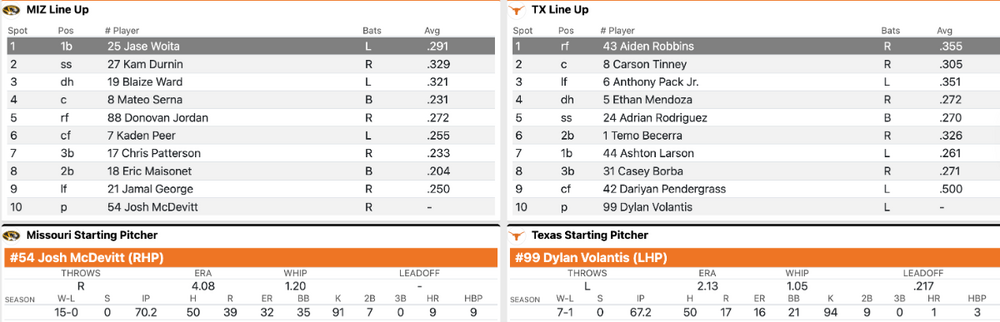
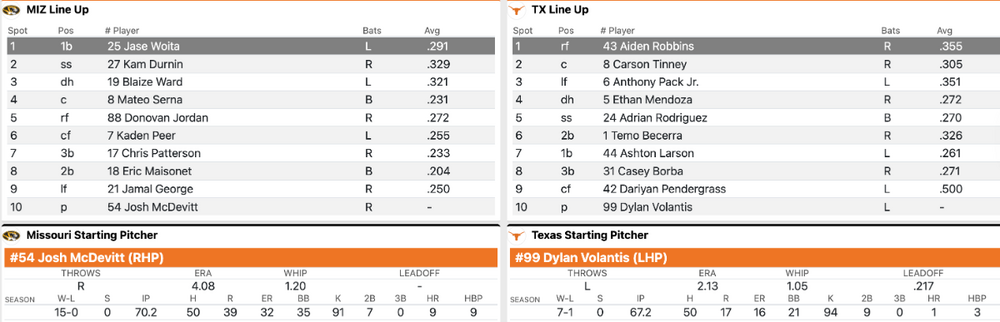
— Pendergrass is back in the lineup in CF. — Becerra is at 2B, Borba moves to 3B and Ashton Larson gets the start at 1B.
-
Since that's the one game I attended this season, I'll take the blame. If @Blake Munroe accepts blame for the baseball series loss at Tennessee, I don't mind being on the hook for the forgettable Kentucky performance.
-
🤘
-
As of 5:55 p.m., we're still waiting on the lineup to be posted.
-
The Longhorns begin a three-game home series with the Tigers on the last weekend of the regular season. The game will be streamed live on SEC Network Plus. On the health/injury front: — Ethan Mendoza (shoulder) will be the designated hitter role only this weekend. — Dariyan Pendergrass isn't listed on the SEC availability report. Schloss said on Wednesday that Pendergrass could play this weekend, but as of yesterday, he wasn't sure. UPDATE: Pendergrass is in the lineup in center field. — Max Grubbs is out for this series. It sounds like he's been dealing with some arm soreness, so he'll get the weekend off.
-
Kentucky was actually 1-of-3 on fourth down. Felt a lot worse though. Vanderbilt was 2-for-2, FWIW.
-
🤘
-
Shoutout to @CJ Vogel for his time-of-possession breakdown, which sent me down a rabbit hole examining play differential. In our Longhorn Blitz days with @Rod Babers, Matt Butler and I, Matt is the one who pointed out play differential as something to look to understand TOP better (kinda like looking at touchdown rate in the red zone instead of conversion rate as a whole when determining success or failure).
-
After reading CJ Vogel’s examination of time of possession as a statistic that must change for Texas to reach its ceiling in 2026, my focus shifted to play differential. It’s not that one statistic is better than the other. I prefer to lean on a team’s play differential (the positive or negative difference between the number of plays a team runs on offense and the number of plays their defense faces) because it’s a more precise measurement of game control. If an opponent leans on an up-tempo offense and runs a lot of plays with a premium on getting more possessions, or if an opponent wants to take the air out of the football and make the game shorter, play differential can paint a more accurate picture than time of possession. No matter how you slice it, when it comes to what the Longhorns did last season, play differential (like time of possession) must improve to maximize the team’s potential. Texas finished the 2025 season with a minus-47 overall play differential (minus-3.6 per game), which ranked 15th in the SEC. Against SEC competition, the Longhorns had the worst total play differential (minus-79) in the conference and ranked last in the SEC in per-game play differential (minus-9.9). In short, Texas’ conference opponents ran roughly 10 more plays per game than the Longhorns. That might not sound like much, but when considering that SEC foes averaged 1.5 scoring drives of 10 or more plays per game against Texas (12 double-digit play scoring drives by SEC opponents in eight conference games), it's a problem that must be fixed. The highest priority to get the issue resolved is the Longhorns running the football better than they did last season, especially in conference play. Only Alabama’s 89.9 rushing yards per game against SEC opponents kept Texas from being the worst rushing offense in the conference, with an average of 93.1 yards per game on the ground in eight conference games. Texas also must do a better job of getting off the field on third and fourth down, which includes being a better defense on first and second down. Pete Kwiatkowski's defense faced an average of 14.7 third downs per game against SEC opponents in 2025, a mark topped only by Oklahoma’s 14.9 for the most in the conference. Even when the Longhorns got third-down stops (a 39.8-percent conversion rate by SEC opponents ranked 10th in the conference, which was well above the defense’s season average of 33.5 percent), only Ole Miss defended more fourth-down conversion attempts (34 in 15 games) than the 31 times the Texas defense was on the field on fourth down. The Longhorns finished fourth in the conference and tied for 30th nationally in fourth-down defense (45.2-percent conversion rate allowed), but only Alabama and Auburn (15 each) allowed more teams to convert on fourth down than the 14 times it happened to the Longhorns. Texas allowed opponents to convert eight of the combined 16 fourth-down attempts it faced against SEC opponents. Without question, coming off a year in which the Longhorns were one of five SEC offenses that failed to run at least 500 plays against conference opponents (499, which tied with Florida for the third fewest in the league), the running game must improve. At the same time, Steve Sarkisian brought Will Muschamp back to the Forty Acres to call the defense so that his aggressive style can create more negative plays to get opponents behind the chains and promote more turnover-forcing opportunities, which must happen for Texas to shrink the wide gap in play differential from last season.
-
After reading CJ Vogel’s examination of time of possession as a statistic that must change for Texas to reach its ceiling in 2026, my focus shifted to play differential. It’s not that one statistic is better than the other. I prefer to lean on a team’s play differential (the positive or negative difference between the number of plays a team runs on offense and the number of plays their defense faces) because it’s a more precise measurement of game control. If an opponent leans on an up-tempo offense and runs a lot of plays with a premium on getting more possessions, or if an opponent wants to take the air out of the football and make the game shorter, play differential can paint a more accurate picture than time of possession. No matter how you slice it, when it comes to what the Longhorns did last season, play differential (like time of possession) must improve to maximize the team’s potential. Texas finished the 2025 season with a minus-47 overall play differential (minus-3.6 per game), which ranked 15th in the SEC. Against SEC competition, the Longhorns had the worst total play differential (minus-79) in the conference and ranked last in the SEC in per-game play differential (minus-9.9). In short, Texas’ conference opponents ran roughly 10 more plays per game than the Longhorns. That might not sound like much, but when considering that SEC foes averaged 1.5 scoring drives of 10 or more plays per game against Texas (12 double-digit play scoring drives by SEC opponents in eight conference games), it's a problem that must be fixed. The highest priority to get the issue resolved is the Longhorns running the football better than they did last season, especially in conference play. Only Alabama’s 89.9 rushing yards per game against SEC opponents kept Texas from being the worst rushing offense in the conference, with an average of 93.1 yards per game on the ground in eight conference games. Texas also must do a better job of getting off the field on third and fourth down, which includes being a better defense on first and second down. Pete Kwiatkowski's defense faced an average of 14.7 third downs per game against SEC opponents in 2025, a mark topped only by Oklahoma’s 14.9 for the most in the conference. Even when the Longhorns got third-down stops (a 39.8-percent conversion rate by SEC opponents ranked 10th in the conference, which was well above the defense’s season average of 33.5 percent), only Ole Miss defended more fourth-down conversion attempts (34 in 15 games) than the 31 times the Texas defense was on the field on fourth down. The Longhorns finished fourth in the conference and tied for 30th nationally in fourth-down defense (45.2-percent conversion rate allowed), but only Alabama and Auburn (15 each) allowed more teams to convert on fourth down than the 14 times it happened to the Longhorns. Texas allowed opponents to convert eight of the combined 16 fourth-down attempts it faced against SEC opponents. Without question, coming off a year in which the Longhorns were one of five SEC offenses that failed to run at least 500 plays against conference opponents (499, which tied with Florida for the third fewest in the league), the running game must improve. At the same time, Steve Sarkisian brought Will Muschamp back to the Forty Acres to call the defense so that his aggressive style can create more negative plays to get opponents behind the chains and promote more turnover-forcing opportunities, which must happen for Texas to shrink the wide gap in play differential from last season. View full news story